
Conversion rate optimization built on data you can trust
More traffic is the expensive way to grow. I look at where visitors drop out of your funnel, find out why, and test changes that get more of them to buy or enquire. It starts with checking the tracking, because a test measured on broken data proves nothing.
The problem you're seeing
Ad costs keep rising and the conversion rate hasn’t moved in months. Product pages get views but few add to cart. Checkout starts outnumber orders by a wide margin. Someone redesigned the homepage and nobody can say whether it helped.
Most CRO advice is a list of generic tips: bigger buttons, more trust badges, shorter forms. Some of it works on some sites. Without knowing where your visitors actually leave and why, you’re guessing, and a guess dressed up as a test still costs you traffic.
Why it happens
›
Funnel reports built on events that fire twice or not at all, so the drop-off you’re trying to fix may not be real.
›
Changes made all at once, so nobody can tell which one moved the number.
›
Tests stopped as soon as a variant looks ahead, before there’s enough data to separate a real lift from noise.
›
Mobile visitors getting the desktop experience squeezed down, when most of the traffic is on phones.
›
Friction the team no longer notices: surprise shipping costs, forced account creation, slow pages, unclear delivery times.
What I do
01
Check the tracking first. Page views, add to cart, checkout steps and purchases should each fire once and match the platform, so the funnel numbers are real.
02
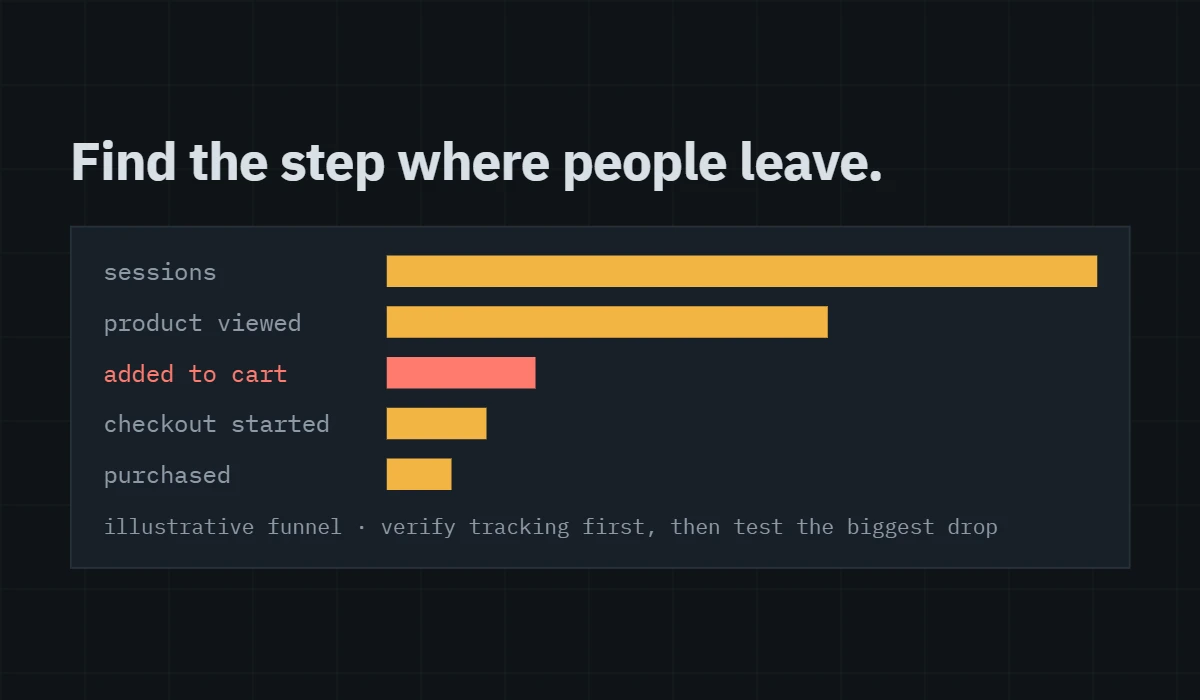
Map the funnel in a GA4 funnel exploration and find the steps with the biggest drop-off, split by device and traffic source.
03
Watch what people do on those steps with Microsoft Clarity heatmaps and session recordings: where they hesitate, scroll past or rage-click.
04
Write a short list of hypotheses ranked by likely impact and effort, and agree with you which to test first.
05
Run one change at a time, as an A/B test where traffic allows or as a measured before-and-after where it doesn’t, and report every result honestly, including the ones that lose.
What you get
A verified funnel in GA4, a written list of the problems I found with the evidence for each, a ranked test plan, and results reported against the metric that matters to you: revenue per visitor, conversion rate or lead quality.
Who this is for
Shopify and WooCommerce stores and lead-generation sites with steady traffic that isn’t converting as well as it should, and teams who have tried CRO tips and can’t tell what worked.
Questions I get asked
How much traffic do I need for A/B testing?
It depends on your current conversion rate and the size of change you want to detect. With low traffic I use before-and-after comparisons over full weeks and bolder changes, and I tell you plainly how confident we can be in the result.
Which testing tool do you use?
It depends on your platform and budget. Shopify and WooCommerce both have testing apps and plugins, and some changes can be run through GTM. I recommend one after seeing your setup.
Do you redesign the whole site?
No. I change the specific elements the data points to, one at a time, so we know what made the difference.
Why start with tracking?
Because a miscounted step sends you after the wrong page. If add to cart fires twice, the drop between cart and checkout looks worse than it is and the fix goes in the wrong place.
Other services
Start with what you can measure.
Tell me what you want to improve and what you’ve already tried. I’ll reply with what I’d look at first and whether I’m the right person for it.